 9s2zd
The Role of NGO Income-Generating Programmes (IGPs) in Entrepreneurship Development in Bangladesh
RESEARCH REPORT
The Role of NGO Income-Generating Programmes (IGPs)
in Entrepreneurship Development in Bangladesh
An Expert Interview and Thematic Analysis
Expert Interviewed
Mst. Fahomedha Begum
Development Practitioner | Economist | Entrepreneurship & MSME Specialist
September 2026
Table of Contents
Table of Contents……………………………………………………………………………………………………………………………. 2
Executive Summary………………………………………………………………………………………………………………………… 3
1. Introduction………………………………………………………………………………………………………………………………… 4
1.1 Background and Rationale……………………………………………………………………………………………………… 4
1.2 Objective of the Report…………………………………………………………………………………………………………… 4
1.3 Methodology…………………………………………………………………………………………………………………………. 4
2. Profile of the Interviewed Expert…………………………………………………………………………………………………… 5
3. Thematic Analysis of Expert Insights…………………………………………………………………………………………….. 6
3.1 The Economic Contribution of IGPs: Beyond Income to Enterprise (Q1, Q3, Q18)………………………… 6
3.2 From Income Activity to Sustainable Enterprise: What Makes the Difference (Q2, Q8, Q9, Q10)……… 6
3.3 Entrepreneur or Self-Employed? A Necessary Distinction (Q4, Q5, Q17)……………………………………… 7
3.4 Designing IGPs That Work: Components, Sequencing and Redesign (Q6, Q7, Q15)……………………… 7
3.5 What Separates Success from Stagnation (Q11, Q12)………………………………………………………………… 8
3.6 Finance and Market Access: The Practical Constraints (Q13, Q14)……………………………………………… 9
3.7 Reaching the Poorest Without Losing Enterprise Potential (Q16)………………………………………………… 9
3.8 Institutional and Policy-Level Barriers (Q19)…………………………………………………………………………….. 9
4. Synthesis: A Segmented, Market-Led Model for IGPs……………………………………………………………………. 11
5. Key Recommendations………………………………………………………………………………………………………………. 11
6. Conclusion……………………………………………………………………………………………………………………………….. 11
Annex A: Expert Interview — Full Questions and Responses…………………………………………………………….. 13
Annex B: About the Expert…………………………………………………………………………………………………………….. 22
Executive Summary
This report presents a thematic analysis of a structured expert interview on the role of NGO income-generating programmes (IGPs) in entrepreneurship development in Bangladesh. The interview covers twenty questions addressing the economic contribution of IGPs, the conditions under which they generate sustainable rather than short-term income, the distinction between self-employment and entrepreneurship, programme design and sequencing, barriers to reinvestment and expansion, access to finance and markets, inclusion of the poorest households, and institutional and policy constraints. The expert interviewed, Mst. Fahomedha Begum, brings over two decades of field-level and programme-management experience with PKSF, the World Bank, IFAD, ADB, JICA and other donor-funded livelihoods and entrepreneurship programmes in Bangladesh, combined with direct entrepreneurial experience in women’s fashion and integrated agriculture.
The analysis finds a consistent argument running through the twenty responses: IGPs are effective instruments for livelihood stabilization and economic inclusion, but they are not, by themselves, entrepreneurship-creation instruments. A smaller and identifiable group of beneficiaries can progress from income earner to entrepreneur, and this progression depends on a specific sequence — a genuine market opportunity, the capability to act on it, and finance matched to the business cycle — held together by continuous mentoring. The report distils this into two working frameworks (Sections 4 and 5) and closes with three strategic recommendations that the expert considers most consequential for NGO practice in Bangladesh: segmentation of beneficiaries by pathway, a defined enterprise-graduation route, and a shift in how programme success is measured.
1. Introduction
1.1 Background and Rationale
NGOs in Bangladesh have run income-generating programmes for several decades as a core instrument of poverty reduction, typically combining skills training, microfinance and, in more recent designs, market linkage and mentoring. As Bangladesh’s development priorities shift toward employment quality, MSME growth and inclusive economic participation, a practical question has become more pressing for programme designers, donors and researchers alike: do these programmes create entrepreneurs, or do they mainly create self-employment and stable household income? The answer matters for how NGOs design interventions, how donors set indicators, and how researchers and policymakers judge programme effectiveness.
This report was prepared to examine that question directly, through a structured interview with a practitioner who has worked across project management, case management, gender and social inclusion, project coordination and grassroots enterprise development within Bangladesh’s NGO-MFI ecosystem, and who has also built and run her own enterprises outside the development sector.
1.2 Objective of the Report
The report has three objectives. First, to organize the twenty interview responses into coherent themes rather than treating them as twenty separate answers. Second, to identify the underlying logic that connects the themes — in particular, the sequence and conditions under which an income-generating activity becomes a sustainable enterprise. Third, to translate that logic into frameworks and recommendations that can inform programme design, monitoring indicators and further academic inquiry into entrepreneurship development in the NGO sector.
1.3 Methodology
The report is based on a single structured expert interview of twenty open-ended questions, administered in a semi-structured format over 40–50 minutes. The interview instrument was designed to probe five broad areas: (i) the economic contribution and impact pathway of IGPs; (ii) the determinants of sustainability, reinvestment and resilience; (iii) the distinction between self-employment and entrepreneurship and the conditions for progression between the two; (iv) programme design, sequencing and institutional barriers; and (v) inclusion of the poorest households alongside beneficiaries with entrepreneurial potential.
The expert was purposively selected for her dual vantage point — as a development practitioner who has implemented and supervised NGO livelihoods and entrepreneurship programmes (RAISE, SUFAL, HILIP and CALIP, ENRICH, and others funded by PKSF, the World Bank and IFAD, among others), and as a practicing entrepreneur who has built and operated enterprises in fashion manufacturing, e-commerce and integrated agriculture. This combination allows the analysis to draw on both the implementer’s and the entrepreneur’s perspective on the same phenomenon. Responses are analyzed qualitatively; direct paraphrase and short attributed statements are used to preserve the expert’s reasoning, and cross-references to the relevant question numbers (Q1–Q20) are provided throughout so the analysis can be traced back to the source material reproduced in full in Annex A.
A methodological note is warranted here. The twenty questions were answered by the report’s author, drawing on her own field experience in NGO livelihoods programming and her personal record as a practising entrepreneur. This is a self-administered, reflexive practitioner interview rather than an exchange with an external party, and it is disclosed as such deliberately: the value of the exercise lies in surfacing tacit, field-level judgment that a practitioner rarely sets out in first-person analytical writing, and the interview format is used here as a structuring device for that reflection. Sections 3–6 should accordingly be read as a structured self-interview and thematic self-analysis, not as third-party expert testimony.
2. Profile of the Interviewed Expert
Table 1 summarizes the professional background of the expert interviewed for this report, drawn from her curriculum vitae, to situate the weight and vantage point of the views analyzed in the sections that follow.
Table 1: Expert Profile Summary
| Attribute | Details |
| Name | Mst. Fahomedha Begum |
| Current Role | Case Management Expert, ISO Component 05 (Package SD-14), a World Bank-financed livelihoods and social development programme; concurrently Project Coordinator, RAISE Project (PKSF and the World Bank), Padakhep Manabik Unnayan Kendra (PMUK) |
| Professional Focus | Livelihoods and economic inclusion, entrepreneurship and MSME development, skills and workforce development, MEAL, GESI, and climate resilience |
| Experience | 20+ years across NGO, government and donor-funded programmes supported by the World Bank, IFAD, ADB, JICA, DFID/FCDO, the European Union, PKSF and the Government of Bangladesh |
| Education | MSS in Entrepreneurship Economics, Dhaka School of Economics, University of Dhaka (2026); MSS in Economics, National University (2005); Postgraduate Diploma in Project Management for NGO & Development (UK, 2025); Atlantic Fellow for Social and Economic Equity (AFSEE), LSE (2026/27) |
| Entrepreneurial Experience | CEO & Dress Designer, Shaheda Desire of Fashion (2016–present); CEO & Co-Founder, Quddus Farm Ranch, an integrated agricultural venture (2021–present); Founder, Women Entrepreneur’s Business Chain, active across 25 districts (2020–2022) |
| Recognition | MIDAS SME Trade Fair Award for entrepreneurial excellence (2019); research presented at the 11th World Sustainability Forum, Barcelona (2025) |
3. Thematic Analysis of Expert Insights
The twenty interview questions are analyzed here under eight themes. Each theme draws on the relevant question numbers, which are cross-referenced to the full transcript in Annex A.
3.1 The Economic Contribution of IGPs: Beyond Income to Enterprise (Q1, Q3, Q18)
The expert’s starting position is that the value of an IGP cannot be measured by counting beneficiaries trained or loans disbursed. Its real contribution operates on two levels. At the household level, a well-designed IGP — one that combines training, finance, technical support and market linkage — can move a beneficiary from irregular, subsistence-level income toward a more stable and diversified livelihood, and for a smaller group, into self-employment or genuine enterprise. At the community level, successful IGPs generate a multiplier effect: expanding businesses buy more local inputs, employ family members or other workers, and circulate income within the local economy (Q1).
This contribution, however, is described as inherently micro and household-level. Most NGO IGPs do not, by themselves, produce broad-based economic growth; their strategic value lies in building a large base of economically active households and microenterprises, particularly where formal employment is scarce. The wider growth effect depends on whether individual enterprises are connected to local economic systems-local supply chains, transport, and service providers and on a demonstration effect, where a successful neighboring entrepreneur changes local perceptions of what is economically possible, especially for women and young people (Q3).
On employment, the expert draws a specific sequence: livelihood support leads to self-employment first, and employment beyond the owner comes later, once the enterprise is commercially viable enough to hire a helper or worker. She links this directly to SDG 8 (Decent Work and Economic Growth), cautioning that programmes should not equate any paid activity with decent work — earnings, safety, working conditions and predictability all matter, not just headcount (Q18).
3.2 From Income Activity to Sustainable Enterprise: What Makes the Difference (Q2, Q8, Q9, Q10)
Four factors recur as determinants of whether an IGP produces sustainable rather than short-term income: genuine and continuing market demand, the beneficiary’s business capacity (beyond technical skill — pricing, cash flow, negotiation, customer retention), finance that is matched in size and timing to the business cycle, and post-training mentoring during the first three to six months, which the expert identifies as the period when a new entrepreneur faces the greatest risk of failure (Q2). Table 2 summarizes these determinants alongside the barriers that most commonly prevent reinvestment and expansion.
Table 2: Determinants of IGP Sustainability and Barriers to Reinvestment
| Determinant of Sustainability (Q2) | Corresponding Barrier to Reinvestment (Q9) |
| Real, continuing market demand for the product or service | Market uncertainty — hesitation to invest without confidence in sales |
| Beneficiary capacity: pricing, cash flow, cost control, customer management | Limited financial and business knowledge — revenue, profit and household cash become mixed |
| Finance matched to business cycle and repayment capacity | Lack of working capital even where the business is profitable |
| Continuous post-training mentoring, especially in the first 3–6 months | Absence of a clear pathway for enterprise progression after initial support |
| Access to inputs, technology, infrastructure and market information | Low and unstable income absorbed by essential household expenses |
| Household support and capacity to reinvest part of income | Gender-specific constraints — limited control over income, mobility restrictions |
Reinvestment itself is treated as the mechanism that converts a temporary income gain into a durable improvement in a household’s income-generating capacity — for example, reinvesting in livestock, equipment, stock or a complementary income source rather than consuming all additional income (Q8). The expert is careful, though, to reject a one-size-fits-all reinvestment target: for a very poor household, stabilizing consumption and building a savings buffer may need to come first; for an established microenterprise, reinvestment in stock or market expansion is more appropriate (Q8).
On resilience, income diversification is described as valuable primarily because it reduces dependence on a single, shock-exposed source of income — relevant in a context where many Bangladeshi households depend on agriculture, casual labour or one small business, all of which are vulnerable to floods, cyclones, illness or price shocks. But the expert distinguishes diversification from genuine resilience: several income sources exposed to the same local market or the same climate risk do not constitute real resilience. Strategic diversification — sources that are complementary rather than merely additional — combined with savings, insurance where feasible, and market information, produces the stronger outcome (Q10).
3.3 Entrepreneur or Self-Employed? A Necessary Distinction (Q4, Q5, Q17)
A central argument in the interview is that most IGPs create self-employment and income earners, not entrepreneurs — and that this is not a programme failure. The expert distinguishes the two by orientation and behavior: a self-employed person runs an activity to meet household needs, while an entrepreneur identifies opportunities, takes calculated risks, organizes resources, innovates and seeks growth beyond their own labour (Q4). Because traditional IGPs are designed primarily around poverty reduction, it is expected — and, in her view, appropriate — that most beneficiaries remain at the self-employment or subsistence level. The mistake, she argues, is expecting every beneficiary to become a growth-oriented entrepreneur (Q4).
Entrepreneurial potential itself is assessed through a combination of individual characteristics (initiative, willingness to learn, persistence, tolerance for calculated risk, and a shift from asking “how much did I earn today?” to “what is my margin, who is my customer, how much should I reinvest?”) and enabling conditions (a viable market, working capital, infrastructure, and — particularly for women — household circumstances such as unpaid care responsibilities, mobility and control over income) (Q5). Motivation without market opportunity, and market opportunity without capability or capital, both fail; the two must be assessed together, which is why the expert argues strongly for segmentation rather than treating all IGP beneficiaries as one homogeneous group (Q5, Q17).
On the specific tension between poverty targeting and entrepreneurial-potential targeting, the expert’s position is that these serve different, non-competing programme objectives: poverty reduction should deliberately include the poorest households even where they are unlikely to become growth-oriented entrepreneurs, while entrepreneurship development requires identifying beneficiaries who show potential and willingness to grow a business. Selection for the latter should not rely only on education or existing business ownership — a beneficiary with limited formal education may show strong entrepreneurial potential through initiative, market understanding and willingness to reinvest (Q17). Her guiding principle: target poverty for inclusion, then segment according to economic pathway and potential (Q17).
3.4 Designing IGPs That Work: Components, Sequencing and Redesign (Q6, Q7, Q15)
Asked to rank the components of entrepreneurship-focused IGPs — skills training, finance, mentoring, market access and technology — the expert declines to rank them in isolation, arguing that the combination matters more than any single component, but identifies market access and market intelligence as the most commonly missing element: NGOs frequently train beneficiaries to produce something without first establishing who will buy it, at what price, and how frequently (Q6). Finance without business capability, she notes, can increase indebtedness rather than build a sustainable enterprise; technology is valuable only where it demonstrably raises productivity, cuts costs, improves quality or opens new markets — not because it is technologically attractive (Q6).
Directly asked to weigh finance, skills and market access against one another as drivers of the transition from IGP to sustainable enterprise, the expert sets out an explicit sequence, which this report treats as the interview’s central analytical contribution (Q15):
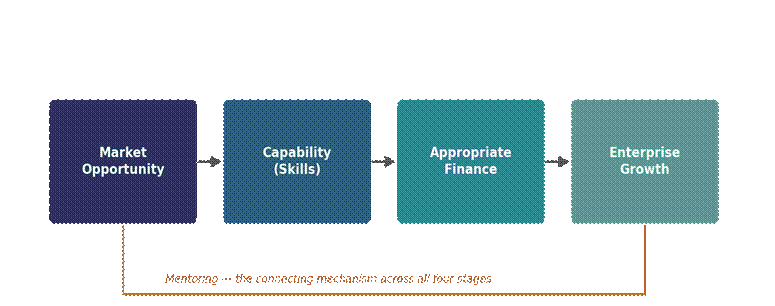
Figure 1. The sequencing logic for transforming an IGP into a sustainable enterprise, as described by the expert (Q15). Mentoring is presented not as a fifth input but as the mechanism that translates the other three into day-to-day business decisions.
The logic is that a market opportunity must exist before skills or finance can produce income: additional finance without demand simply increases unsold stock, and better technical skills without demand increase production without increasing income. Once a viable opportunity is identified, skills determine whether the entrepreneur can compete and manage the business, and finance then allows the entrepreneur to act on the opportunity (Q15).
This sequencing directly informs the expert’s recommended redesign of NGO IGPs (Q7): segmentation of beneficiaries into livelihood-support, self-employment and growth-oriented tracks; market-led selection of activities, based on an assessment of local demand, competition and value chains, rather than choosing the activity first and hoping a market exists; an explicit graduation pathway, in which finance and support scale up as the beneficiary demonstrates business performance; strengthened post-start-up mentoring during the highest-risk early months; stronger linkages to private-sector buyers, e-commerce platforms and financial institutions; and a shift in monitoring indicators away from “numbers trained” and “loans disbursed” toward business survival, revenue growth, reinvestment and employment creation (Q7).
3.5 What Separates Success from Stagnation (Q11, Q12)
Continuous learning, motivation, perseverance and entrepreneurial orientation matter, particularly once a beneficiary has started operating an activity, because markets rarely stay still — customer preferences shift, input prices move, competitors enter. But the expert is explicit that perseverance should not be treated as an individual’s sole responsibility: a business can fail because the market was weak, the programme selected the wrong activity, or finance and market support were inadequate, and unsuccessful beneficiaries should not automatically be labelled as “less entrepreneurial” (Q11).
Comparing beneficiaries whose activities grow against those that stagnate at subsistence level, four behavioral distinctions recur: the ability to adapt the product or activity to what customers actually want, financial discipline (separating business revenue from household income, maintaining stock, saving for working capital), customer orientation (knowing and retaining regular customers rather than depending on one-off sales), and active information-seeking (comparing suppliers and prices, learning new techniques) (Q12). The expert again cautions against a purely individual-characteristics explanation: location, household resources, access to roads and markets, social networks, gender norms and exposure to shocks also shape outcomes, and sometimes the programme itself placed a beneficiary in an activity with limited market potential (Q12).
3.6 Finance and Market Access: The Practical Constraints (Q13, Q14)
On finance, the expert’s assessment is that Bangladesh’s NGO-MFI ecosystem has meaningfully improved access to working capital for very small activities, but that access becomes inadequate exactly at the point where a microenterprise is ready to expand: financing needs exceed conventional microcredit limits, while formal banks require collateral, documentation or financial records that the entrepreneur cannot easily provide. She also flags a mismatch between rigid, typically monthly repayment structures and business cycles — agriculture and seasonal trading in particular — and the risk that multiple borrowing (using one loan to repay another) can mean additional finance without actual enterprise growth (Q13). Her recommendation is a graduated financing ecosystem: start-up capital, working capital, growth finance for proven businesses, and stronger links to formal financial institutions as enterprises mature, accompanied by business record-keeping and cash-flow assessment (Q13).
On market access, she argues that for many microentrepreneurs the market — not production — is the binding constraint: weak bargaining power in small-quantity buying and selling, dependence on intermediaries who limit price information, inconsistent quality, packaging or delivery capacity relative to what larger buyers require, and gaps in market information about what to produce, for whom, at what quality and price (Q14). She recommends NGO support through producer groups, aggregation, buyer-seller linkages, digital market platforms and quality support — moving beneficiaries from isolated individual sellers to better-connected market participants (Q14).
3.7 Reaching the Poorest Without Losing Enterprise Potential (Q16)
NGOs in Bangladesh have strong community-level outreach, but the expert separates reaching the poorest from helping them achieve sustainable economic outcomes — these are not the same achievement. The poorest households often have the least capacity to absorb business risk (limited assets, lower literacy, restricted mobility, heavy care responsibilities), and conventional IGP models can unintentionally favor beneficiaries who are easier to train or already better resourced — a selection bias that can produce good implementation results without reaching the poorest (Q16). Her recommended response is a two-stage approach: use transparent poverty and vulnerability criteria to ensure the poorest are included, then tailor the intervention to capacity — asset support, foundational skills and social protection linkages for the poorest, moving directly into enterprise development for those with stronger capacity — with inclusion tracked through disaggregated data on gender, disability, age, location and poverty level (Q16).
3.8 Institutional and Policy-Level Barriers (Q19)
At the institutional level, the expert identifies five recurring constraints on NGOs becoming more effective instruments of entrepreneurship and economic growth, summarized in Table 3.
Table 3: Institutional and Policy Barriers Identified (Q19)
| Barrier | Description |
| Fragmentation of support | Entrepreneurs interact separately with finance, training, registration and market-support providers that are not connected to one another |
| Input- and activity-oriented funding and reporting | Funding and reporting systems emphasize numbers trained or loans disbursed rather than enterprise survival or growth |
| Short project cycles | Enterprise development can take several years, while donor-funded project cycles are typically much shorter |
| Formalization and compliance barriers | Taxation, licensing, financial documentation and institutional procurement requirements are difficult for microenterprises to meet |
| Limited longitudinal outcome tracking | Beneficiaries are typically measured only immediately after training or loan disbursement, so survival two or three years later is rarely known |
4. Synthesis: A Segmented, Market-Led Model for IGPs
Bringing the eight themes together, the interview converges on a single structural argument: NGOs should stop designing IGPs as one uniform intervention and instead run a segmented model in which the same poverty-targeting entry point branches into three distinct pathways, each with its own objective, support package and success measure (Q4, Q5, Q7, Q16, Q17, Q20). Figure 2 sets out this model.
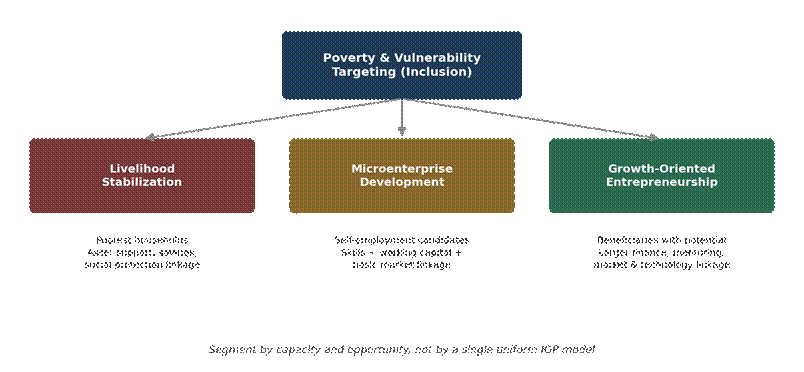
Figure 2. A segmented, market-led IGP model synthesized from the interview. Poverty and vulnerability targeting remains the single entry point for inclusion; the intervention that follows is then matched to household capacity and market opportunity rather than applied uniformly.
Two design principles hold this model together. First, inclusion and pathway are decided separately: the poorest are included on vulnerability criteria regardless of their entrepreneurial prospects, and the pathway assigned afterward is a capacity-and-opportunity decision, not a gatekeeping filter that excludes the poorest from the programme altogether (Q16, Q17). Second, within the microenterprise and growth-oriented tracks, the market-opportunity-first sequencing set out in Figure 1 governs the order in which skills, finance and mentoring are introduced — activities are not selected and then matched to a market after the fact (Q15).
5. Key Recommendations
Asked directly for the three strategic changes she would prioritize for NGO IGPs in Bangladesh, the expert names segmentation, a graduation pathway, and a change in success metrics (Q20). Table 4 sets these out alongside the supporting reasoning drawn from across the interview.
Table 4: Three Priority Recommendations (Q20)
| Recommendation | Rationale and Supporting Evidence |
| 1. Move from a uniform IGP model to a segmented, market-led model | Not every beneficiary needs the same intervention or has the same capacity; activity selection should follow an assessment of local demand, competition and value chains rather than preceding it (Q4, Q7, Q15, Q17). |
| 2. Establish a clear enterprise-graduation pathway | Support should not stop at training or initial credit; beneficiaries with demonstrated performance should progress through skills, start-up support, working capital, mentoring, market linkage and growth finance in stages (Q7, Q13, Q15). |
| 3. Change how programme success is measured | Move beyond counting beneficiaries, training days and loans disbursed toward longitudinal indicators — enterprise survival, revenue and profit growth, reinvestment, employment creation and resilience to shocks (Q7, Q19, Q20). |
A single principle runs beneath all three recommendations: NGOs should not attempt to turn every poor person into an entrepreneur. Poverty reduction and entrepreneurship development are related but distinct objectives — a stable livelihood is a valid and valuable outcome in its own right, while enterprise growth and job creation should be pursued deliberately with the smaller group of beneficiaries who show genuine potential (Q20).
6. Conclusion
Across the twenty questions examined in this report, one argument holds consistently: NGO income-generating programmes in Bangladesh are, first and foremost, effective instruments of livelihood stabilization and economic inclusion, and they should be judged and funded on that basis for the majority of beneficiaries they reach. Entrepreneurship, in the fuller sense of opportunity recognition, calculated risk-taking and deliberate growth, emerges from a smaller subset of that same population, under a specific and identifiable sequence of conditions — a real market opportunity, matched capability, appropriately timed finance, and sustained mentoring through the highest-risk early period of operation.
The practical implication for programme design is to stop treating these as one undifferentiated task. Segmenting beneficiaries by pathway, building a genuine graduation route between pathways, and measuring outcomes over years rather than at the point of training or disbursement would, in the expert’s assessment, allow IGPs to deliver more consistently on both objectives — the immediate reduction of poverty for the many, and enterprise development and job creation for the few with the potential and the opportunity to achieve it. This distinction offers a useful frame for further academic and applied research on entrepreneurship development within Bangladesh’s NGO and MFI sector.
Annex A: Expert Interview — Full Questions and Responses
The following is the complete set of twenty questions and responses on which the analysis in Sections 3–5 is based, reproduced here for reference and traceability.
| Q1. In your opinion, how do NGO income-generating programmes (IGPs) contribute to the economic development of beneficiaries and their communities in Bangladesh? | In my experience, NGO income-generating programmes contribute to economic development in Bangladesh in several ways, but their impact goes beyond simply providing a beneficiary with a loan, training, or an income-generating activity. At the beneficiary level, a well-designed IGP can help a low-income household move from irregular or subsistence-level income towards a more stable and diversified livelihood. When training, finance, technical support and market linkage are provided together, beneficiaries can improve an existing business, start a new enterprise, increase productivity, or move from wage employment into self-employment. This is particularly important for women and other groups who have limited access to formal employment or productive assets. However, I would distinguish between an income-generating activity and an enterprise. Not every IGP beneficiary will become an entrepreneur, and not every small activity has the potential to grow. The real contribution of an NGO programme depends on whether it helps beneficiaries develop the capacity to make business decisions, understand customers and markets, manage cash flow, control costs, maintain quality, and reinvest profits. At the community level, successful IGPs can create a multiplier effect. When beneficiaries expand their businesses, they purchase more inputs from local suppliers, employ family members or other workers, generate demand for local services, and circulate additional income within the local economy. I also see IGPs as an important instrument for economic inclusion. Many NGO clients have limited access to formal finance because of collateral requirements, lack of financial history, low literacy, geographic isolation or informal employment. But I would not measure IGP success simply by the number of people trained or loans disbursed. We need to look at enterprise survival, income growth, productivity, reinvestment, employment creation and whether the activity remains viable after NGO support is reduced. So, in my view, the strongest contribution of IGPs is creating a pathway from livelihood support to economic participation and, for a smaller but important group, from economic activity to genuine entrepreneurship and enterprise growth. |
| Q2. What factors determine whether an IGP creates sustainable income rather than only short-term income? | The first factor is whether there is a real and continuing market for the product or service. I have seen many programmes where beneficiaries receive training and finance for the same traditional activities without sufficient assessment of local demand. In that situation, the programme may create many small businesses but not necessarily sustainable businesses. The second factor is the beneficiary’s capacity. Technical skill is important, but it is not enough. A person may know how to produce a product but may not know how to price it, calculate profit, manage working capital, negotiate with suppliers, retain customers or respond to competition. The third factor is the adequacy and timing of finance. Working capital that arrives too late, or a loan that is either too small for the business or too large for the beneficiary’s capacity, can create problems. Finance needs to be matched with the business cycle and repayment capacity. I would also highlight post-training support. In many programmes, the strongest support is provided before the activity starts and then gradually disappears. But the first three to six months are often when a new entrepreneur faces the greatest problems. Regular mentoring, business counselling and problem-solving support can make a significant difference. Other factors include access to inputs, technology, infrastructure, market information, household support, climate and disaster risks, and the beneficiary’s ability to reinvest part of the income. Ultimately, sustainability comes from business viability, not from continued programme support. An IGP becomes sustainable when the beneficiary can generate sufficient revenue, control costs, manage risks, retain customers and reinvest without depending continuously on NGO assistance. |
| Q3. To what extent can NGO IGPs contribute to long-term economic growth at the household and local-community levels? | I would say the contribution can be significant, but it depends heavily on the scale and design of the programme. An IGP by itself does not generate broad-based economic growth. Its contribution becomes more meaningful when individual enterprises are connected to wider local economic systems. At household level, regular income can improve consumption stability, children’s education, housing conditions, nutrition, savings and the ability to cope with unexpected expenditure. More importantly, if the household begins to accumulate productive assets rather than only consuming the additional income, the programme can contribute to longer-term economic mobility. At community level, the effect comes through local economic linkages. A growing enterprise buys raw materials, uses transport, engages service providers and may hire workers. One successful enterprise can therefore generate income for several other people. There is also an important demonstration effect. When beneficiaries see a neighboring woman successfully operating a food business, tailoring enterprise, agricultural venture or retail activity, it can influence perceptions about what is economically possible, particularly for women and young people. But we should be realistic. Most NGO IGPs operate at micro and household level. Their direct macroeconomic contribution will therefore be limited. Their strategic value is in building a large base of economically active households and microenterprises, particularly in areas where formal employment opportunities are limited. For long-term growth, IGPs need to move beyond beneficiary numbers and strengthen productivity, enterprise graduation, employment creation, value-chain participation and access to larger markets. |
| Q4. In your view, do NGO IGPs actually create entrepreneurs, or do they mainly create self-employment and income earners? Why? | I would say both, but predominantly self-employment and livelihood generation. There is an important difference between being self-employed and being an entrepreneur. A person running a small shop alone to meet household expenses is economically active and may be highly capable, but that does not necessarily mean the person is pursuing enterprise growth. An entrepreneur, in my understanding, is more likely to identify opportunities, take calculated risks, organize resources, innovate, respond to market changes and seek growth beyond their own labour. Many traditional IGP models are designed primarily around poverty reduction. Their immediate objective is to help households generate income. Therefore, it is understandable that a large proportion of beneficiaries remain at the self-employment or subsistence level. This is not necessarily a programme failure. For the poorest households, stable income may itself be a major achievement. The mistake is expecting every beneficiary to become a growth-oriented entrepreneur. Where IGPs include beneficiary segmentation, business-oriented training, appropriate finance, mentoring, market linkage and opportunities for reinvestment, a proportion of beneficiaries can progress into more commercially oriented enterprises. So, I would not recommend changing every IGP into an entrepreneurship programme. Rather, NGOs should create different pathways: one for livelihood stabilization, one for microenterprise development, and another for beneficiaries with genuine potential and ambition for enterprise growth. |
| Q5. What characteristics or conditions are necessary for an IGP beneficiary to progress from income earner to entrepreneur? | I would look at both individual characteristics and the surrounding business environment. At the individual level, the beneficiary needs some degree of initiative, willingness to learn, persistence, problem-solving ability and tolerance for calculated risk. Importantly, entrepreneurial potential does not mean that someone must already be a successful businessperson. It can be developed through exposure, coaching and practical experience. Business orientation is also important. The beneficiary needs to think beyond “How much did I earn today?” and gradually start asking questions such as “What is my margin?”, “Who is my customer?”, “How can I increase repeat sales?”, and “How much should I reinvest?” But individual motivation alone cannot compensate for a poor business environment. The enterprise also needs a viable market, access to inputs, working capital, technology where relevant, infrastructure and reasonable regulatory conditions. Household circumstances matter as well. For women, for example, unpaid care responsibilities, mobility restrictions and control over income can directly influence whether an enterprise can grow. I would therefore assess entrepreneurial potential through a combination of motivation, capability, business behavior and opportunity. A beneficiary with strong motivation but no market opportunity needs a different intervention from someone who already has customers but lacks capital or management skills. That is why I strongly support segmentation rather than treating all IGP beneficiaries as one homogeneous group. |
| Q6. Which components of IGPs are most important for entrepreneurship creation — skills training, finance, mentoring, market access, technology, or other support? | I would not rank these components in isolation because their value depends on the stage of the enterprise. In practice, the combination is more important than any single component. If I had to identify the most commonly missing element, I would point to market access and market intelligence. NGOs sometimes invest heavily in training beneficiaries to produce something without sufficiently answering the basic question: Who will buy it, at what price, and how frequently? Finance is also essential, but finance without business capability can increase indebtedness rather than create a sustainable enterprise. Similarly, skills training can improve production quality but does not automatically create customers. Mentoring is particularly important during the transition from training to actual business operation. A mentor or case supervisor can help the beneficiary identify why sales are declining, whether pricing is correct, how much stock to purchase, or when to reinvest. Technology becomes critical where it increases productivity, reduces production costs, improves quality or provides access to new markets. It should not be introduced simply because it is technologically attractive. So my preferred model is a market-led package: assess the opportunity, provide the relevant technical and business skills, facilitate appropriate finance, provide mentoring during the early stage, and connect the enterprise with buyers and suppliers. For entrepreneurship development, the question should not be “How much training did we provide?” but rather “What changed in the way the beneficiary operates the business?” |
| Q7. How can NGOs redesign their IGPs to increase the number of beneficiaries who establish and grow their own businesses? | The first redesign should be segmentation. Not every beneficiary wants to become an entrepreneur, and not everyone has the same capacity or opportunity. NGOs should distinguish between livelihood-support beneficiaries, self-employment candidates and growth-oriented enterprise candidates. Second, programme design should become more market-led. Before selecting an IGP, NGOs should assess local demand, competition, price trends, input availability and potential buyers. Training should follow market opportunity rather than the other way around. Third, I would introduce a graduation pathway. A beneficiary might begin with skills and a small productive asset, then receive working capital after demonstrating basic business capability, followed by larger finance or market linkage when the enterprise reaches specific milestones. Fourth, NGOs need to strengthen post-start-up mentoring. The period immediately after business initiation is critical. Beneficiaries need practical support with costing, pricing, cash flow, inventory, customer management and reinvestment. Fifth, NGOs should develop stronger linkages with private-sector buyers, wholesalers, e-commerce platforms, financial institutions, government services and local business associations. Finally, programme indicators should change. Instead of focusing primarily on “number trained” and “number financed”, NGOs should track business survival, revenue growth, profit, reinvestment, employment creation and enterprise graduation. That would shift IGPs from an activity-based model towards an enterprise-development model. |
| Q8. How important is the reinvestment of IGP income in agriculture, small business, productive assets or other income-generating activities for sustainable economic improvement? | Reinvestment is one of the most important mechanisms through which a temporary income increase can become longer-term economic improvement. If all additional income is immediately consumed, the household may experience a short-term improvement but its productive capacity may remain unchanged. When part of the income is reinvested in livestock, equipment, inventory, agricultural inputs, technology, shop expansion or another viable income source, the household’s capacity to generate future income increases. However, I would not suggest that beneficiaries should maximize reinvestment regardless of their circumstances. Poor households have genuine consumption needs. Education, food, healthcare, housing and debt repayment may be more urgent. The key is productive reinvestment according to the household’s stage and capacity. For a very poor household, stabilizing consumption and building a small savings buffer may need to come before business expansion. For an established microenterprise, reinvestment in stock, equipment or market expansion may be much more appropriate. NGOs can play an important role here by helping beneficiaries understand the difference between sales revenue, profit and cash available for reinvestment. I would also encourage diversification of productive assets where appropriate. For example, an agricultural household may combine crop production with livestock or small trading activities to reduce dependence on a single source of income. Therefore, reinvestment is not simply about putting more money into the same activity. It is about building the household’s future income-generating capacity. |
| Q9. What are the major barriers that prevent beneficiaries from reinvesting their IGP income and expanding their economic activities? | The first barrier is simply low and unstable income. For very poor households, income is often absorbed by food, education, healthcare, rent, debt servicing and other essential expenses. Expecting significant reinvestment from very low-margin activities is unrealistic. The second is lack of working capital. Even when a business is profitable, the entrepreneur may not have enough cash to purchase larger quantities of inputs or stock. A third barrier is limited financial and business management knowledge. Some beneficiaries cannot clearly distinguish between revenue, profit and household cash. As a result, business money and household money become mixed. Market uncertainty is another major issue. If beneficiaries are not confident that additional production will generate sales, they naturally hesitate to invest. Women face additional constraints in some contexts, including limited control over income, mobility restrictions, household responsibilities and lack of decision-making power over productive assets. Climate shocks, illness, disasters, sudden household expenses and price volatility can also force households to withdraw business capital. There is also a programme-design issue. Some IGPs create an activity but do not provide a clear pathway for enterprise progression. The beneficiary receives initial support, but there is little follow-up on what happens when the business is ready to expand. Therefore, reinvestment requires more than financial literacy. Beneficiaries need sufficient margins, financial discipline, confidence in the market, access to appropriate capital and a supportive household and institutional environment. |
| Q10. To what extent can income diversification through IGPs improve household financial stability and resilience? | Income diversification can substantially improve household resilience because it reduces dependence on a single source of income. This is particularly relevant in Bangladesh because many low-income households depend heavily on agriculture, casual labour, seasonal employment or one small business. These sources can be affected by floods, cyclones, illness, market price changes, unemployment or seasonal fluctuations. If a household has two or three complementary income sources, a shock to one source does not necessarily eliminate all income. For example, an agricultural household may combine farming with livestock, small trading or home-based production. However, diversification should not mean simply adding more activities. Too many small activities can spread the household’s limited capital and labour too thinly. The objective should be strategic diversification, based on household capacity, market opportunity and risk. There is also a difference between diversification and genuine resilience. A household may have several activities but still remain vulnerable if all of them depend on the same local market or the same climate-sensitive resource. NGOs can therefore strengthen resilience by combining IGPs with savings, appropriate financial services, insurance or risk-management mechanisms where feasible, climate-resilient livelihood options, skills development and market information. In my view, the strongest outcome is when diversification creates a household portfolio in which income sources are complementary rather than competing. |
| Q11. How important are continuous learning, motivation, perseverance and entrepreneurial orientation in determining the success of IGP beneficiaries? | They are very important, particularly once the beneficiary has started operating the activity. The market rarely remains unchanged. Customer preferences change, input prices fluctuate, competitors enter, technology changes and unexpected shocks occur. A beneficiary who is willing to learn and adapt is therefore more likely to survive these changes than someone who simply follows the original business plan. Perseverance is also important, but I would be careful about treating it as an individual responsibility alone. Sometimes a business fails because the market is weak, the programme selected the wrong activity, or the beneficiary did not receive adequate finance or market support. We should not label every unsuccessful beneficiary as lacking motivation. Entrepreneurial orientation is reflected in behavior: seeking new customers, testing new products, improving quality, controlling costs, responding to feedback and identifying opportunities. NGOs can strengthen these characteristics through practical coaching rather than motivational sessions alone. For example, asking an entrepreneur to analyze last month’s sales, identify the three best-selling products and develop a plan to improve the weakest-performing product is much more useful than simply telling them to “work harder.” Continuous learning should therefore be built into the programme through peer learning, mentoring, business clinics, market exposure and practical problem-solving. |
| Q12. In your experience, what distinguishes successful IGP beneficiaries from those whose activities fail or remain at a subsistence level? | One clear difference is the ability to adapt. Successful beneficiaries tend not to remain rigidly attached to the original activity or product. They observe what customers want and adjust accordingly. Another difference is financial discipline. They generally have a better understanding of cash flow and avoid treating all business revenue as household income. They are more likely to maintain stock, save for working capital and reinvest part of the profit. Customer orientation is another important characteristic. Successful small entrepreneurs know their regular customers, understand what they value and often build relationships rather than depending entirely on one-off sales. I also find that successful beneficiaries actively seek information. They ask other traders about prices, compare suppliers, learn new techniques and look for new markets. However, there is an important caveat: success cannot be explained only by personal characteristics. Location, household resources, access to roads and markets, social networks, gender norms, access to finance and exposure to shocks also influence outcomes. For that reason, I would avoid describing unsuccessful beneficiaries simply as “less entrepreneurial.” Sometimes the programme itself has placed a beneficiary in an activity with limited market potential. The distinction is therefore a combination of behavior, capability, opportunity and enabling conditions. |
| Q13. How adequate is access to finance for IGP beneficiaries who want to start or expand an enterprise? | Access to finance has improved considerably through the NGO-MFI ecosystem in Bangladesh, but I would not say that access is adequate for all enterprise stages. For very small activities, microfinance can often provide useful working capital. The problem becomes more visible when a viable microenterprise wants to expand. Its financing requirements may exceed conventional microcredit limits, while formal banks may require collateral, documentation, financial records or other conditions that the entrepreneur cannot easily provide. There is also a mismatch between the loan product and the business cycle. Agriculture, seasonal trading and some production businesses may not generate regular monthly cash flow, whereas repayment structures can be relatively rigid. Another concern is multiple borrowing. If an entrepreneur uses one loan to repay another or takes several loans from different sources, additional finance does not necessarily mean enterprise growth. What is needed is a more graduated financing ecosystem: small start-up capital for appropriate beneficiaries, working capital for operating enterprises, larger growth finance for proven businesses, and stronger links to formal financial institutions as enterprises become more established. Financial access should also be accompanied by business records, financial literacy and cash-flow assessment. So, the issue is not simply “Do beneficiaries have access to credit?” The more important question is “Do they have access to the right amount, at the right time, at an appropriate cost and with repayment terms compatible with their business?” |
| Q14. What are the major supply chain and market access barriers faced by IGP beneficiaries? | For many microentrepreneurs, market access is a bigger constraint than production itself. The first problem is weak bargaining power. Small producers usually purchase inputs in small quantities and sell products in small quantities. They therefore often face higher input prices and lower selling prices than larger market actors. The second issue is dependence on intermediaries. Intermediaries are not necessarily negative — they provide important aggregation, transport and market functions — but beneficiaries can become dependent on one buyer and have limited information about the final market price. Quality consistency is another barrier. Small producers may be technically capable but unable to maintain consistent quality, packaging, quantity and delivery schedules required by larger buyers. Transportation and storage also matter, particularly for agricultural and perishable products. Digital access does not automatically solve these problems if the entrepreneur lacks logistics or digital business skills. Market information is another major gap. Beneficiaries need information not only about where to sell but also about what to produce, for whom, at what quality and at what price. NGOs can address these barriers through producer groups, aggregation, buyer-seller linkages, business fairs, digital market platforms, packaging and quality support, supplier networks and relationships with private-sector off-takers. The objective should be to move beneficiaries from isolated individual sellers to better-connected market participants. |
| Q15. Which is more critical for transforming an IGP into a sustainable enterprise: access to finance, skills, or market access? Why? | I would not treat these as competing factors. They are three parts of the same enterprise system. But if I have to identify the starting point, I would start with market opportunity. If there is no sufficient demand, additional finance can simply increase the amount of unsold stock, and better technical skills can increase production without increasing income. Once a viable market opportunity is identified, skills determine whether the entrepreneur can produce competitively and manage the business. Finance then allows the entrepreneur to act on that opportunity. The sequence is therefore important: market opportunity → capability → appropriate finance → business growth. For example, giving a beneficiary a loan to produce a product that has very low local demand is unlikely to create a sustainable enterprise. Conversely, if there is strong demand but the entrepreneur lacks technical skills or working capital, the opportunity cannot be captured. I would also add mentoring as the connecting mechanism among the three. Mentoring helps translate training and finance into day-to-day business decisions. So, rather than asking which single component is most important, I would say that market-led design is the foundation, skills are the capability, and finance is the enabling capital. |
| Q16. How effectively do NGOs ensure that IGP benefits reach the poorest and most economically vulnerable households? | NGOs in Bangladesh have considerable experience in reaching poor and excluded populations, and their community-level networks are a major strength. However, reaching the poorest and helping them achieve sustainable economic outcomes are two different things. The poorest households may have limited assets, lower literacy, restricted mobility, heavy care responsibilities and very little capacity to absorb business risk. They may therefore be less likely to participate successfully in conventional IGP models. There is also a risk of selection bias. Programmes may unintentionally favour beneficiaries who are easier to train, more mobile, already have some assets, or have stronger family support. From an implementation perspective these beneficiaries may produce better results, but they may not be the poorest. I would therefore recommend a two-stage approach. First, use transparent poverty and vulnerability criteria to ensure inclusion. Second, tailor the economic intervention according to the beneficiary’s capacity. The poorest may require asset support, foundational skills, savings, social protection linkages or a gradual livelihood pathway before taking on business risk. Those with stronger capacity may move directly into enterprise development. Inclusion should also be monitored through disaggregated data — gender, disability, age, location, poverty level and other relevant vulnerability characteristics. So, NGOs are relatively strong at outreach, but the next challenge is ensuring that outreach translates into meaningful and sustainable economic inclusion. |
| Q17. How should NGOs balance poverty targeting with the selection of beneficiaries who have genuine entrepreneurial potential? | I would not see poverty targeting and entrepreneurial potential as mutually exclusive. The key is to recognize that they represent different programme objectives. If the objective is poverty reduction, the programme should deliberately include the poorest households even if they are unlikely to become growth-oriented entrepreneurs. Their pathway may be livelihood stabilization rather than enterprise expansion. For entrepreneurship development, however, NGOs need to identify beneficiaries who demonstrate potential and willingness to grow a business. I would therefore recommend a segmented programme model. A first group could receive livelihood and income-stabilization support. A second group could receive microenterprise development support. A smaller third group with stronger potential could receive more intensive entrepreneurship support, including larger finance, mentoring, technology and market linkage. Selection should not rely only on education or existing business ownership. A poor person with limited formal education may have strong entrepreneurial potential. Assessment should consider initiative, business interest, problem-solving, market understanding, existing customer relationships, willingness to reinvest and capacity to manage risk. At the same time, NGOs should avoid turning “entrepreneurial potential” into a gatekeeping mechanism that excludes the poorest. The principle I would follow is: target poverty for inclusion, then segment according to economic pathway and potential. |
| Q18. To what extent do IGPs create employment beyond self-employment and contribute to decent work and SDG-8? | Most traditional IGPs create self-employment first. Employment beyond the beneficiary usually comes later, when the activity becomes commercially viable and begins to grow. A small enterprise may initially be operated entirely by the owner. As sales increase, the entrepreneur may hire a helper, apprentice, salesperson, production worker or seasonal worker. At that point the IGP begins generating a wider employment effect. This is where the connection with SDG 8 — decent work and economic growth — becomes more meaningful. We should not measure employment only by the number of people earning something. We should also consider the quality of work: reasonable earnings, safety, working conditions, non-discrimination, skills development and predictability of employment. For example, an enterprise employing several people but paying very low wages or providing unsafe working conditions should not automatically be presented as a strong decent-work outcome. NGO programmes can strengthen this pathway by supporting enterprises with productivity improvement, formalization where appropriate, labour standards awareness, apprenticeships, business management and access to growth finance. They should also track whether supported enterprises create additional jobs and whether those jobs are sustained. So IGPs can contribute to SDG 8, but the pathway is generally livelihood → self-employment → enterprise growth → additional employment → improved quality of work. Not every IGP beneficiary will reach the final stages, and programme expectations should reflect that reality. |
| Q19. What are the major policies or institutional barriers preventing NGO IGPs from becoming more effective instruments of entrepreneurship and economic growth? | One institutional issue is the fragmentation of support. Entrepreneurs often interact with different organizations for finance, training, registration, market support and technical assistance, but these services are not always connected. Another issue is that many programmes are still heavily input- and activity-oriented. Funding and reporting systems may emphasize numbers trained, loans disbursed, groups formed or assets distributed. These are important implementation indicators, but they do not tell us whether enterprises survived or grew. Short project cycles can create another problem. Enterprise development requires time. A beneficiary may need several years to move from a small livelihood activity to a stable enterprise, while development projects may operate on much shorter funding cycles. There are also barriers related to formalization, taxation, licensing, access to institutional procurement, financial documentation and the ability of microenterprises to meet formal market requirements. For women and other excluded groups, institutional barriers can be combined with social and household-level constraints. I would also highlight the limited use of longitudinal outcome tracking. If an NGO measures beneficiaries only immediately after training or loan disbursement, it cannot know whether the enterprise survives two or three years later. Therefore, a stronger policy environment would encourage coordination, longer-term enterprise support, simplified formalization, appropriate finance, market integration and outcome-based monitoring. |
| Q20. If you could recommend three strategic changes to improve NGO IGPs in Bangladesh, what would they be? | If I had to recommend only three changes, my first recommendation would be to move from a uniform IGP model to a segmented, market-led model. Not every beneficiary needs the same intervention. NGOs should distinguish between livelihood protection, self-employment, microenterprise and growth-oriented entrepreneurship. Before selecting an activity, they should assess market demand, competition, value chains and local economic opportunities. My second recommendation would be to establish a clear enterprise graduation pathway. Support should not stop at training or initial credit. Beneficiaries with potential should be able to progress through stages — skills, start-up support, working capital, mentoring, market linkage and growth finance — based on demonstrated business performance. My third recommendation would be to change the way programme success is measured. NGOs should move beyond counting beneficiaries, training days and loans. We need longitudinal indicators such as enterprise survival, revenue and profit growth, productive asset accumulation, reinvestment, employment creation, women’s economic decision-making and resilience to shocks. I would add one principle across all three recommendations: do not try to turn every poor person into an entrepreneur. Poverty reduction and entrepreneurship development are related but different objectives. A stable livelihood is a valuable outcome in itself, while a smaller group of beneficiaries may have the potential to build growing enterprises and create jobs. If NGOs can make that distinction clearly and design different pathways accordingly, I believe IGPs can become much more effective instruments not only for income generation, but also for economic mobility, enterprise development and inclusive local economic growth in Bangladesh. |
Annex B: About the Expert
This report’s author, Mst. Fahomedha Begum, has spent more than two decades inside Bangladesh’s NGO and donor-funded development sector, moving across case management, gender and social inclusion, and grassroots enterprise support. Her present assignment sits within ISO Component 05 (Package SD-14), a livelihoods and social development programme financed by the World Bank and delivered through Padakhep Manabik Unnayan Kendra; alongside it, she coordinates Padakhep’s RAISE Project, backed by PKSF and the World Bank.
Over that career she has worked on programmes carried by PKSF, the World Bank, IFAD, ADB, JICA, DFID/FCDO, the European Union and the Government of Bangladesh, building a practice that runs from livelihoods and economic inclusion through entrepreneurship and MSME development, skills and workforce development, MEAL, and climate resilience.
Outside that institutional work, she owns and runs Shaheda Desire of Fashion, a women’s fashion and manufacturing business she has led since 2016, and co-founded Quddus Farm Ranch, an integrated agricultural venture, in 2021. Between 2020 and 2022 she also founded and ran the Women Entrepreneur’s Business Chain, an e-commerce platform for handcrafted goods that reached 25 districts. It is this combination — years spent implementing donor-funded livelihoods programmes and years spent running her own businesses — that the interview in this report is designed to draw out, and the fashion venture’s MIDAS SME Trade Fair Award in 2019 is one marker of it.
She is completing an MSS in Entrepreneurship Economics at the Dhaka School of Economics, University of Dhaka, and was named a Mid-Career Fellow of the Atlantic Fellowship for Social and Economic Equity at the London School of Economics and Political Science for 2026/27.
